

As a supplier of 254SMO stainless steel pipes, I often encounter inquiries about the flow capacity of these pipes. The flow capacity of a pipe is a crucial factor in various industrial applications, as it determines the efficiency and effectiveness of fluid transportation systems. In this blog post, I will delve into the concept of flow capacity, explore the factors that influence the flow capacity of 254SMO stainless steel pipes, and provide some practical insights for optimizing flow performance.
Understanding Flow Capacity
Flow capacity refers to the maximum volume of fluid that a pipe can transport per unit of time under specific conditions. It is typically measured in units such as cubic meters per hour (m³/h) or gallons per minute (GPM). The flow capacity of a pipe is influenced by several factors, including the pipe's diameter, length, roughness, and the properties of the fluid being transported, such as its viscosity and density.
Factors Affecting the Flow Capacity of 254SMO Stainless Steel Pipes
Pipe Diameter
The diameter of a pipe is one of the most significant factors affecting its flow capacity. According to the Hagen - Poiseuille's law for laminar flow (applicable for low - velocity, viscous fluids) and the Darcy - Weisbach equation for turbulent flow (more common in industrial applications), the flow rate is proportional to the fourth power of the pipe diameter in laminar flow and is highly dependent on the diameter in turbulent flow as well. A larger diameter pipe generally allows for a higher flow capacity because it provides a greater cross - sectional area for the fluid to pass through. For example, if we double the diameter of a pipe, the cross - sectional area increases by a factor of four, which can significantly enhance the flow capacity.
Pipe Length
The length of the pipe also plays a role in determining its flow capacity. As the fluid travels through the pipe, it experiences frictional losses due to the interaction between the fluid and the pipe wall. Longer pipes result in greater frictional losses, which reduce the flow capacity. In the Darcy - Weisbach equation, the head loss (a measure of the energy lost due to friction) is directly proportional to the length of the pipe. Therefore, when designing a fluid transportation system, minimizing the pipe length whenever possible can help to improve the flow capacity.

Pipe Roughness
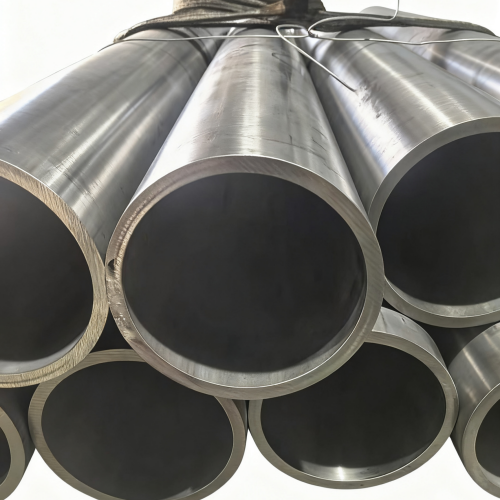
The internal surface roughness of the pipe affects the flow characteristics and, consequently, the flow capacity. 254SMO stainless steel pipes have a relatively smooth internal surface, which is beneficial for fluid flow. A smooth surface reduces the frictional resistance between the fluid and the pipe wall, allowing the fluid to flow more freely. In contrast, pipes with a rough internal surface can cause turbulence and increased frictional losses, leading to a lower flow capacity.
Fluid Properties
The properties of the fluid being transported, such as viscosity and density, have a significant impact on the flow capacity. Viscosity is a measure of a fluid's resistance to flow. High - viscosity fluids, such as heavy oils, flow more slowly than low - viscosity fluids, such as water. The density of the fluid also affects the flow, as it influences the pressure and momentum of the fluid. When dealing with different fluids, it is essential to consider these properties when calculating the flow capacity of 254SMO stainless steel pipes.
Calculating the Flow Capacity of 254SMO Stainless Steel Pipes
To calculate the flow capacity of 254SMO stainless steel pipes, we can use the Darcy - Weisbach equation for turbulent flow:
[h_f = f\frac{L}{D}\frac{V^{2}}{2g}]
where (h_f) is the head loss due to friction, (f) is the Darcy friction factor, (L) is the length of the pipe, (D) is the diameter of the pipe, (V) is the average velocity of the fluid, and (g) is the acceleration due to gravity.
The flow rate (Q) can be calculated from the average velocity (V) using the formula (Q = A\times V), where (A=\frac{\pi D^{2}}{4}) is the cross - sectional area of the pipe.
The Darcy friction factor (f) can be determined using the Moody chart, which is a graphical representation of the relationship between the Reynolds number ((Re=\frac{\rho VD}{\mu}), where (\rho) is the fluid density and (\mu) is the fluid viscosity), the relative roughness of the pipe ((\frac{\epsilon}{D}), where (\epsilon) is the absolute roughness of the pipe surface), and the friction factor (f).
Comparison with Other Stainless Steel Pipes
When comparing the flow capacity of 254SMO stainless steel pipes with other types of stainless steel pipes, such as 904L UNS N08904, several factors come into play. 254SMO has excellent corrosion resistance, which means that its internal surface remains smooth over time, maintaining a relatively consistent flow capacity. In contrast, if a pipe made of a less corrosion - resistant material experiences corrosion, the internal surface can become rough, leading to increased frictional losses and a reduced flow capacity.
Both 254SMO and 904L are considered super - stainless steels, but 254SMO has a higher molybdenum and nitrogen content, which gives it better pitting and crevice corrosion resistance in aggressive environments. This corrosion resistance can be crucial in maintaining the integrity of the pipe and its flow capacity, especially in applications where the fluid contains corrosive substances.
Optimizing the Flow Capacity of 254SMO Stainless Steel Pipes
Proper Sizing
Selecting the appropriate pipe diameter is essential for optimizing the flow capacity. Engineers should conduct detailed calculations based on the expected flow rate, fluid properties, and system requirements to determine the most suitable pipe size. Oversizing the pipe can lead to increased costs, while undersizing can result in insufficient flow capacity and potential operational problems.
Minimizing Bends and Fittings
Bends, elbows, and other fittings in a pipe system can cause additional frictional losses and disrupt the flow. By minimizing the number of bends and using smooth - radius fittings, the flow capacity can be improved. For example, using long - radius elbows instead of short - radius elbows can reduce the pressure drop and enhance the flow.
Regular Maintenance
Regular maintenance of the 254SMO stainless steel pipes is crucial to ensure their long - term performance. This includes inspecting the pipes for signs of corrosion, damage, or blockages. Cleaning the pipes periodically can also help to remove any deposits that may accumulate on the internal surface and affect the flow capacity.
Conclusion
The flow capacity of 254SMO stainless steel pipes is influenced by multiple factors, including pipe diameter, length, roughness, and fluid properties. As a supplier of 254SMo UNS S31254 pipes, we understand the importance of providing high - quality pipes that can meet the specific flow requirements of our customers. By considering the factors discussed in this blog post and following the optimization strategies, it is possible to achieve efficient and reliable fluid transportation using 254SMO stainless steel pipes.
If you are in need of 254SMO stainless steel pipes for your project and want to discuss the flow capacity requirements and other technical details, please feel free to contact us. We are ready to provide you with professional advice and high - quality products to meet your needs.
References
- Incropera, F. P., & DeWitt, D. P. (2002). Fundamentals of Heat and Mass Transfer. John Wiley & Sons.
- Munson, B. R., Young, D. F., & Okiishi, T. H. (2009). Fundamentals of Fluid Mechanics. John Wiley & Sons.
- Perry, R. H., & Green, D. W. (1997). Perry's Chemical Engineers' Handbook. McGraw - Hill.


