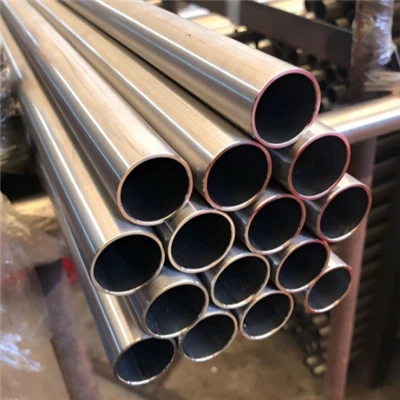
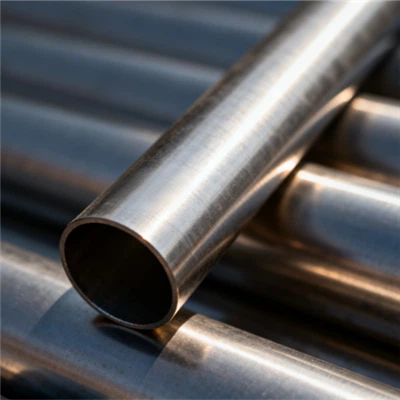
Palladium alloy tubes are used to separate hydrogen from impurities.
The principle of palladium tubes for purifying hydrogen is that when the hydrogen to be purified is passed into one side of the palladium tube at 300-500°C, hydrogen is adsorbed on the wall of the palladium tube. Since the 4d electron layer of palladium lacks two electrons, it can form an unstable chemical bond with hydrogen (this reaction between palladium and hydrogen is reversible). Under the action of palladium, hydrogen is ionized into protons with a radius of 1.5×10¹⁵m, while the lattice constant of palladium is 3.88×10⁻¹⁰m (at 20°C), so it can pass through the palladium tube. Under the action of palladium, protons combine with electrons and re-form hydrogen molecules, escaping from the other side of the palladium tube. On the surface of the palladium tube, undissociated gas cannot pass through, so palladium tubes can be used to obtain high-purity hydrogen. Although palladium has unique permeability to hydrogen, pure palladium has poor mechanical properties, is easily oxidized at high temperatures, has a low recrystallization temperature, and is easy to deform and embrittle the palladium tube, so pure palladium cannot be used as a permeable membrane. Adding appropriate amounts of IB and VIII group elements to palladium to make palladium alloys can improve the mechanical properties of palladium. 11. Seamless steel pipes for automobile half-axle sleeves (GB3088-82) are high-quality carbon structural steel and alloy structural steel hot-rolled seamless steel pipes used to manufacture automobile half-axle sleeves and drive axle axle housings. In palladium alloys, silver accounts for about 20-30%, and the content of other components (such as gold, etc.) is less than 5%.
In the currently used palladium alloys, silver accounts for about 20-30%, and the content of other components (such as gold, etc.) is less than 5%. The rate of hydrogen permeation through palladium alloys is related to temperature, membrane thickness, and the pressure difference (P) between raw hydrogen and pure hydrogen on both sides of the permeation membrane. Increasing temperature, increasing P and reducing membrane thickness will increase the hydrogen permeation rate. However, increasing temperature will reduce the tensile strength of the permeation membrane. Therefore, the use temperature of palladium tubes is usually controlled at around 450°C. Certain impurities can cause palladium poisoning, deteriorate the permeability, and even damage the membrane. Substances that can cause palladium poisoning include: mercury, arsenide, halide, oil vapor, sulfur-containing and ammonia-containing substances, and dust. Palladium alloys can be made into tubular shapes (called palladium tubes) or diaphragms (called palladium membranes).
ABS alloy tubes and special cold melt adhesives are one of them. They are widely used in building water supply and central air conditioning, especially in building water supply risers and central air conditioning pipes. PC/ABS alloys can also be used to make automotive exterior parts, such as car wheel covers, reflector housings, taillight covers, etc. PC/ABS has good formability and can be used to process large automotive parts, such as car fenders.
As an important part of steel products, alloy tubes are divided into two categories: seamless steel tubes (round billets) and welded steel tubes (plates, strip billets) due to their manufacturing processes and different shapes of tube billets used.
The principle of purifying hydrogen with a palladium tube is that when the hydrogen to be purified is passed into one side of the palladium tube at 300-500°C, the hydrogen is adsorbed on the wall of the palladium tube. Since the 4d electron layer of palladium lacks two electrons, it can form an unstable chemical bond with hydrogen (this reaction between palladium and hydrogen is reversible) under the action of palladium.