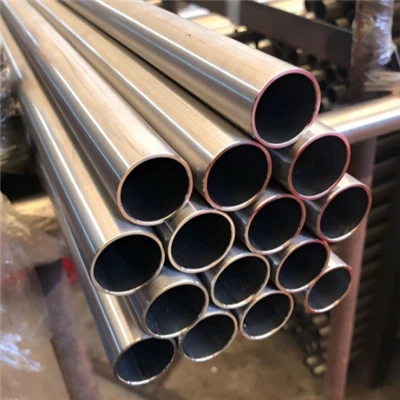
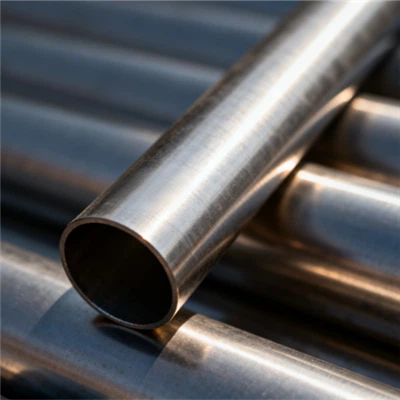
The manufacturing process of alloy tubes plays a decisive role in their performance and quality. Common manufacturing processes include hot rolling, cold rolling, cold drawing, etc.
1. Hot rolling process
- Billet preparation: First, it is necessary to prepare suitable billets, generally using continuous casting billets or rolled billets. The quality and dimensional accuracy of the billets have an important impact on the subsequent rolling process. Before the billets enter the hot rolling mill, they need to be heated to reach the appropriate rolling temperature. The heating temperature is usually determined according to the material composition of the alloy tube, generally between 1000-1300.
- Hot rolling process: The heated billets are fed into the hot rolling mill for rolling. The hot rolling mill is usually composed of multiple rollers, and the billets are gradually rolled into the desired pipe shape under the action of the rollers. During the hot rolling process, due to the high billet temperature, the metal has good plasticity and is prone to deformation. By controlling parameters such as the speed of the rollers, the rolling pressure, and the number of rolling passes, the size and shape of the alloy tube can be accurately controlled. The alloy tube after hot rolling has good comprehensive mechanical properties, but its surface quality is relatively poor, and its dimensional accuracy is not as good as that of cold rolling and cold drawing.
- Cooling treatment: After hot rolling, the alloy tube needs to be cooled. There are many cooling methods, such as air cooling, water cooling, etc. Different cooling methods will affect the microstructure and performance of the alloy tube. Air cooling has a slow cooling speed, and the microstructure of the alloy tube is relatively uniform and has good toughness; water cooling has a fast cooling speed, which can improve the strength and hardness of the alloy tube, but may cause large residual stress inside the alloy tube.
2. Cold rolling process
- Billet preparation: The billet of the cold rolling process is usually a hot-rolled pipe, which needs to be surface treated to remove the oxide scale and impurities on the surface to ensure the smooth progress of the cold rolling process. The size and shape of the billet also need to meet the requirements of the cold rolling mill.
- Cold rolling process: The prepared billet is fed into the cold rolling mill for rolling. Cold rolling is a rolling process carried out at room temperature. Due to the poor plasticity of metal at room temperature, rolling is relatively difficult. Cold rolling mills usually use multiple passes to gradually reduce the outer diameter and wall thickness of the tube to achieve the required dimensional accuracy and surface quality. During the cold rolling process, the rolling force, rolling speed and lubrication conditions need to be strictly controlled to prevent defects such as cracks and peeling in the tube.
- Annealing treatment: There is a large residual stress inside the alloy tube after cold rolling, and the organizational structure will also change, resulting in increased hardness and reduced plasticity. In order to eliminate residual stress and improve the organizational structure and performance of the alloy tube, annealing treatment is required. The annealing temperature and time are determined according to the material composition of the alloy tube and the amount of cold rolling deformation. The general annealing temperature is between 500-800. The alloy tube after annealing has good plasticity and toughness, which can meet the requirements of subsequent processing and use.
3. Cold drawing process
- Billet preparation: The billet of the cold drawing process also needs to be surface treated and dimensionally inspected. The outer diameter and wall thickness of the billet need to meet the requirements of the cold drawing die. In order to reduce the friction during the cold drawing process, lubricant needs to be applied to the billet surface.
- Cold drawing process: The blank is placed in the die of the cold drawing machine, and the blank is passed through the die by the tensile force, thereby reducing the outer diameter and wall thickness of the tube. The cold drawing process can achieve high dimensional accuracy and good surface quality. Cold drawing usually adopts multi-pass drawing, and the deformation amount of each pass needs to be reasonably controlled according to the material of the alloy tube and the bearing capacity of the die.
- Post-processing: The alloy tube after cold drawing also needs appropriate post-processing, such as heat treatment, straightening, etc. Heat treatment can eliminate the residual stress generated during the cold drawing process and improve the performance of the alloy tube; straightening can ensure the straightness of the alloy tube and meet the use requirements.